ByJohn A
AI Infrastructure vs Traditional IT Systems
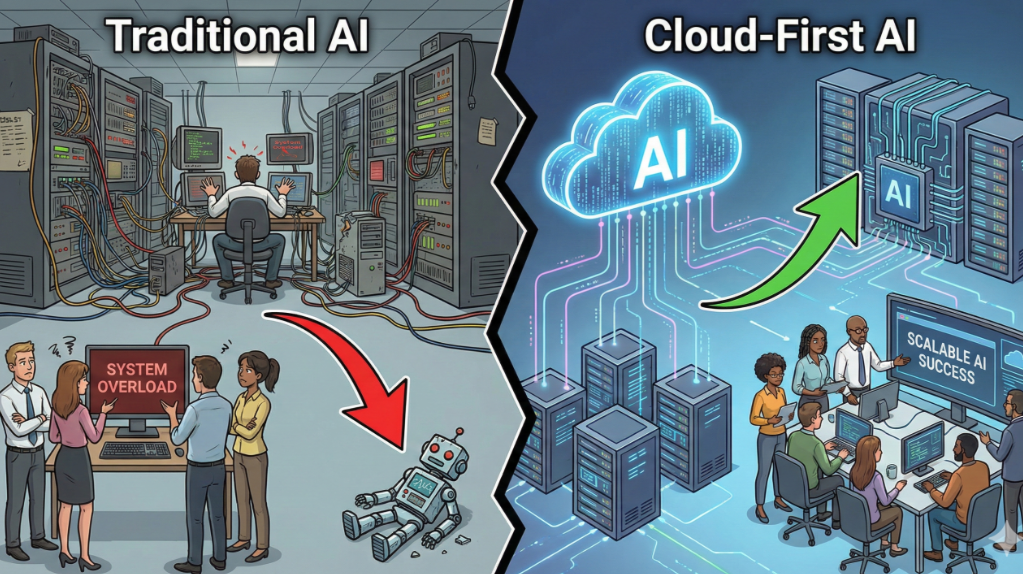
AI infrastructure reframes capability by aligning compute, data, and models to measurable outcomes, unlike static IT stacks. Traditional systems struggle with idle capacity, slow deployment, and siloed governance. A practical framework—people, process, platform—emerges to support continuous experimentation with clear accountability. The shift promises speed, resilience, and demonstrable ROI, yet the path is nuanced: governance at scale, provenance, and cross-functional collaboration must evolve in tandem with metrics that matter. The implications invite deeper examination.
What AI Infrastructure Really Changes in Practice
AI infrastructure reshapes operational fundamentals by eliminating idle capacity, accelerating deployment cycles, and aligning compute, data, and models with measurable outcomes.
It reframes governance, data lineage, and model deployment as continuous disciplines, not checkpoints.
Teams chase cost optimization while preserving autonomy, enabling scalable experimentation, transparent accountability, and rapid iteration.
The result is disciplined freedom, driven by metrics and strategic foresight.
How Traditional IT Stacks Fall Short for AI Workloads
Traditional IT stacks, built for static, predictable workloads, struggle to scale with AI’s dynamic, data-driven demands. They reveal AI limitations through hardware constraints, software compatibility, and data governance gaps, while energy efficiency and capacity planning suffer.
Scaling challenges, vendor lock-in, licensing models, and API maturity impede deployment agility, latency, and fault tolerance.
Observation, monitoring complexity, and integration hurdles hinder model lifecycle, security controls, and change management toward cost optimization and freedom.
A Practical Framework to Bridge the Gap (People, Process, Platform)
A practical framework to bridge the gap rests on three interdependent pillars—People, Process, and Platform—each designed to translate AI ambitions into measurable outcomes.
The framework emphasizes scalable governance, transparent data lineage, and data provenance reliability to enable autonomous decision-making with accountability.
It champions metrics-driven roadmaps, cross-functional alignment, and measurable value while sustaining freedom to pursue innovative, responsible AI through disciplined execution.
Real-World Impacts: Speed, Resilience, and ROI
Across organizations deploying AI infrastructure, speed, resilience, and return on investment become the triad that translates capability into competitive advantage.
Real-world pilots reveal accelerated decision cycles, fewer outages, and measurable ROI through predictive maintenance, automation, and scaled analytics.
AI governance and data sovereigntyframes ensure compliant, auditable outcomes.
Strategic metrics quantify performance, risk, and value, guiding disciplined investment and sustainable, freedom-enabled innovation.
Frequently Asked Questions
How Should Organizations Measure Ai-Ready Cost of Ownership?
AI readiness dictates measuring AI-ready cost of ownership through metrics for governance models, cost transparency, benchmarking vendors, security scalability, and infrastructure risk, while addressing skills gap and ongoing optimization to ensure scalable, freedom-oriented organizational growth.
What Governance Models Best Suit AI Infrastructure Adoption?
Governance models best suited for AI infrastructure adoption emphasize clear AI adoption accountability, data ownership, and cross-functional decision rights; they enable visionary, metrics-driven strategies, empowering freedom-seeking leaders to align ethics, compliance, and innovation with scalable governance.
Which Vendors Offer Unbiased AI Benchmarking for Workloads?
Like a compass in fog, unbiased benchmarking guides vendors toward truth in workload evaluation; several firms offer impartial AI benchmarking, including independent labs and consortiums. These groups promote transparent metrics, enabling freedom-driven choices through robust, objective workload measurements.
How Can Security Complexities Scale With AI Systems?
Security complexities scale with AI systems through layered governance models, proactive vendor benchmarking, and measurable risk metrics; addressing security threats and data leakage, while closing skills gaps, aligning resources, and optimizing governance, as freedom-minded organizations pursue resilient, scalable architectures.
What Skills Gap Poses the Biggest AI Infrastructure Risk?
The biggest AI infrastructure risk stems from the data engineering skills gap, where mismanaged data labeling and hidden data silos undermine model integrity, scalability, and governance, demanding visionary, metrics-driven, freedom-oriented leaders to harmonize provenance and performance.
Conclusion
AI infrastructure redefines IT as a living, measurable system—no idle cycles, just calibrated outcomes. Traditional stacks pretend predictability; AI infrastructure delivers it as performance, provenance, and governance in motion. Ironically, the more dynamic the demand, the more disciplined the control becomes. Metrics drive experimentation, not whim. The prize is speed with resilience and tangible ROI, achieved through cross-functional alignment. In the end, vision becomes value, and value becomes verifiable progress, not a fleeting target.